Sunday, August 28, 2022

Holiday in Adria 2022 - part 3

From Premuda we sailed around Silba and anchored on W side of Olib in the afternoon. The sun slowly dried up the clouds and the summer weather was back. It was too late for snorkelling, but it was just right for a nice swim and a gin&tonic.
Next morning Olib looked pretty as always and I couldn't wait for the sun to climb high enough in the sky to go snorkelling. And Olib didn't disappoint. Almost right next to our boat I found the White Sea-Squirt (Bradavičasti kozolnjak or Phallusia mamillata).
There were also several small Common stingrays (Navadni morski biči or Dasyatis pastinaca) there.
I still get excited if I manage to make a photo of a really very shy Peacock worm (Pahljačasti cevkar or Sabella pavonina).
There were plenty of gobies of all kinds there - this one is a Giant goby (Skalni glavač or Gobius cobitis).
And this was my first Italian Keyhole Limpet (Italijanska strešica or Diodora italica). Only back at home I managed to figure out what it was.
I saw plenty of Mediterranean intertidal hermit crab (Zelenkasti obrežni samotarec or Clibanarius erythropus). Searching around in Internet back home taught me that it is also called St Piran's hermit crab in UK, named after the saint St Piran, patron saint of Cornwall. It disappeared from UK in 1980, probably due to the pollution, and is very slowly returning in recent years. It's definitely not rare in Adria.
This is the same kind of crab, but this one not only has the much fancier house, but a garden as well. On his house the red algae Golden seaweed (Topovejnata lavrencija or Laurencia obtusa) is growing.
As always in Olib I saw lots of tunicates, this is one of the social seasquirts (zadružni plaščarji).
These Green ormers (Petrovi ušesi or Haliotis lamellosa) were laying in the sand just like this, without my interference.
Late in the afternoon we sailed to the E side of Silba and in the evening we had a delicious dinner in restaurant Vrata Velebita. After the dinner we sailed back to Olib, there was a bit of NE wind forecast for the night and it could be uncomfortable on E side of Silba. Next morning the weather was great and the water nice and pretty and turquoise. 
I was lucky that we were not in a hurry, so after a late breakfast I got to go snorkelling again. 
And just because they are so pretty, here's a whole family of white sea squirts.
I often see scallops in Olib, this time I found a Bald scallop (Mala pokrovača or Protopecten glaber)...
...and a Mediterranean scallop (Velika pokrovača or Pecten jacobeus).
On these Mediterranean fan worms (Spalancanijev cevkar or Sabella spallanzanii) there were sepia eggs attached, they are those black grapes tied to the tubes of the worms.
This was one of the catches of the day - a Mottled sea hare (Veliki morski zajček or Aplysia fasciata). I don't see them too often.

And here are couple of more gobies - this one is a Rock goby (Mrki glavač or Gobius paganellus)...
...and this a Black goby (Črni glavač or Gobius niger)
Here the sepia eggs are attached to the tube of a tube worm, you can see that the tentacles of the worm are inside the tube.
This strange thing became not just the catch, but also the mystery of the day, I really couldn't figure out what it could be, so I took the photos from all sides. 
Only when looking at the photos on my computer I figured out that there is a shell on the bottom and on the top there is a big fleshy body, so I figured it must be a snail. And only at home by consulting all of my books I realised it was an Italian Keyhole Limpet (Italijanska strešica or Diodora italica), the kind that I already photographed the day before, only upside-down this time. It would make my detective work a bit easier had I turned it, but I never touch anything under water, I don't want to frighten or damage the pretty things.
I don't know whom these chimneys belong, but they are covered with Bryozoan (mahovnjak).
The shy Peacock worms (Pahljačasti cevkar or Sabella pavonina) come in many different colours. If you are lucky enough to come close to see them.
I was really happy to have the opportunity to snorkel in Olib twice and since the holiday was slowly ending I thought that snorkelling was more or less over for this summer.
In the middle of the day we sailed off and in late afternoon anchored on SW side of Lošinj in bay Sunfarni. We had a nice lazy evening with lots of swimming and nice dinner. Next day we sailed towards Unije but on the way stopped on N side of Lošinj near the small rocky island of Karbarus. It is a nice-weather anchorage only, because it's very open, but water is even more blue than in Olib. I had to go snorkelling and was very pleasantly surprised.
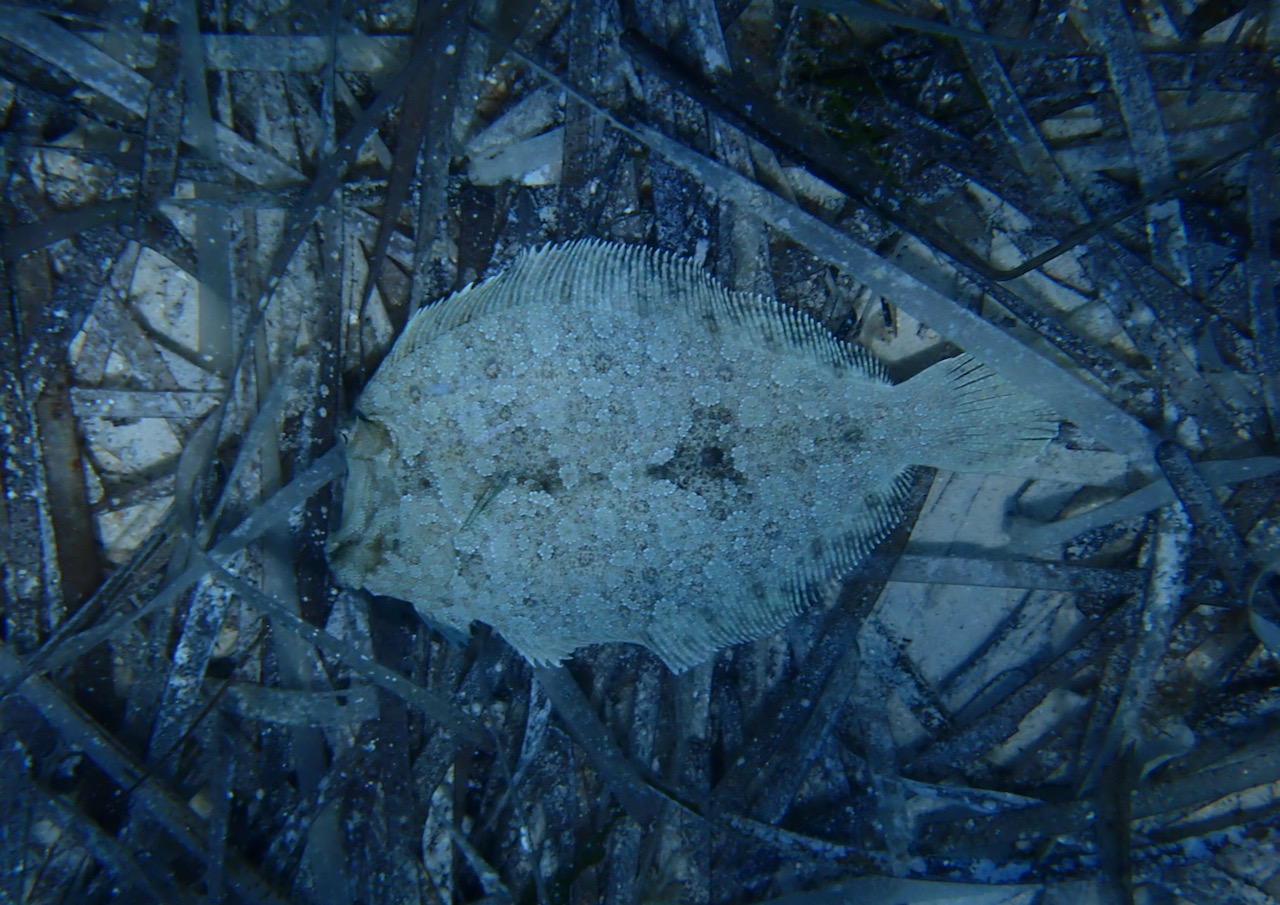
First I saw two guys that I don't see very often - Wide-eyed flounders (Širokogledi romb or Bothus podas).
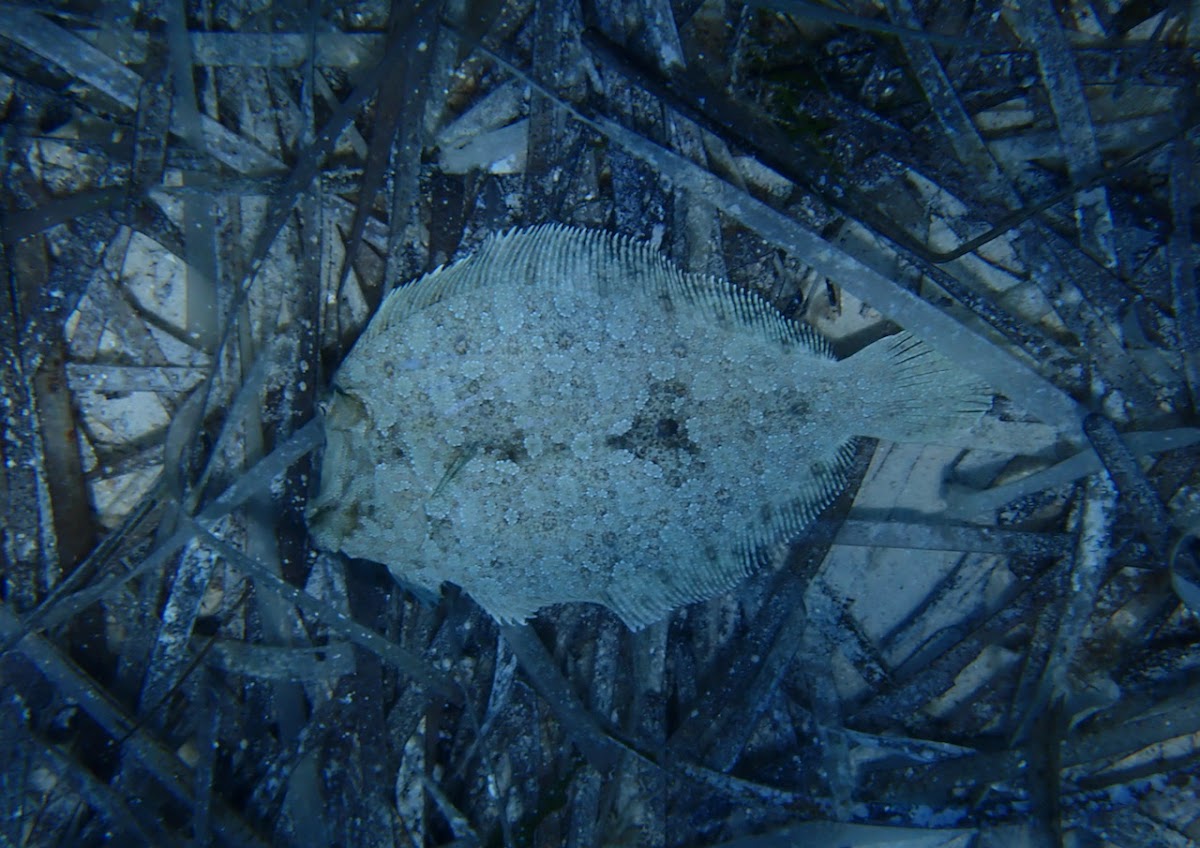
Look how wide apart their eyes are, much more than with common flounder. And it is difficult to comprehend, that all flounders have eyes on each side of the head like all other fish when they are born and only later one eye travels towards the other eye on the "upper" side of body.
The biggest surprise were many octopuses that I saw, this one was looking quite frightened.
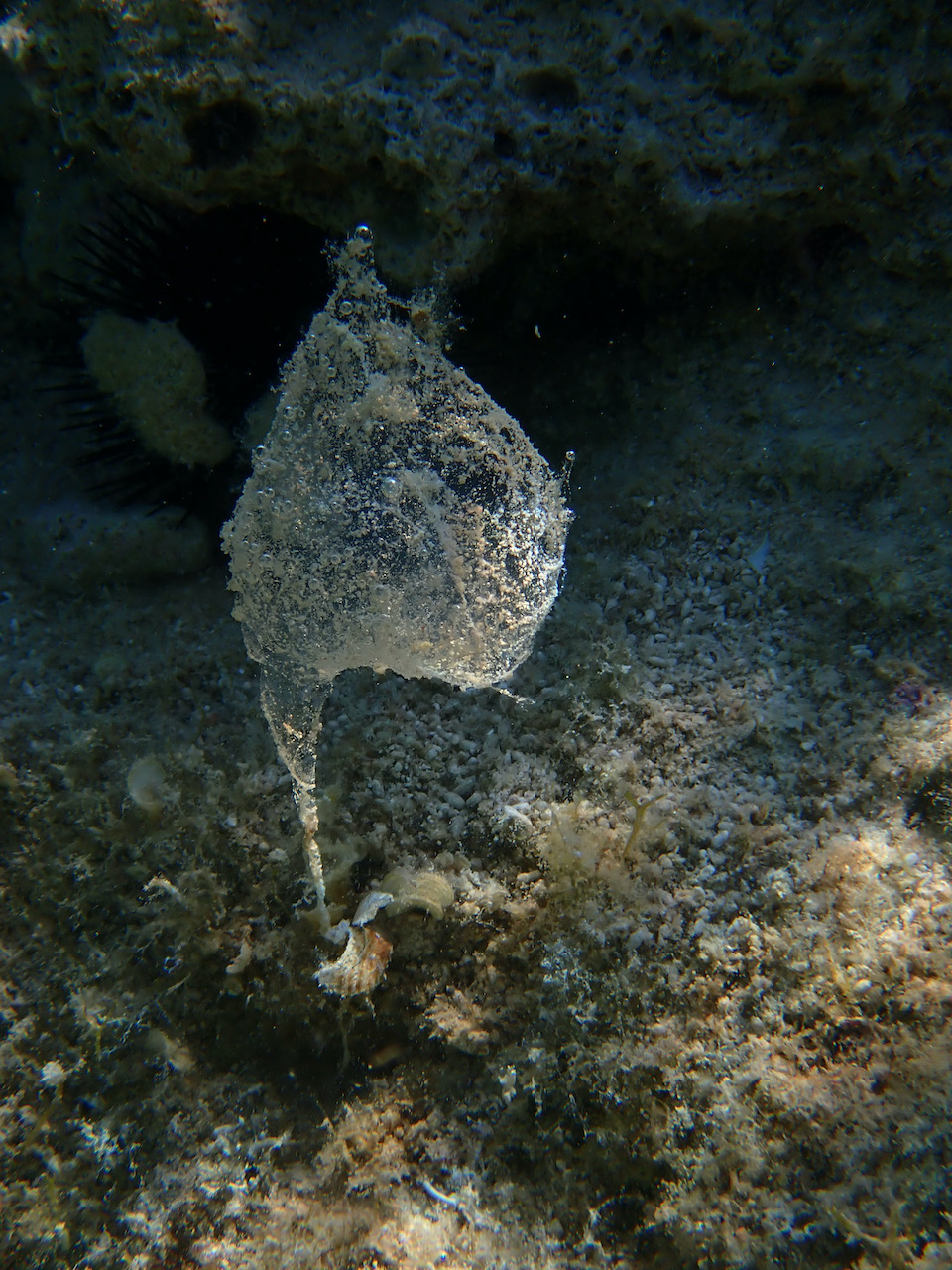
I again saw gelatinous balls, but this one looked like a sack and the funny thing was that it was pulsating. Usually they are not moving.
This one wasn't moving, and on my computer I saw that above it was another very small one. I still have no ideas what it might be.
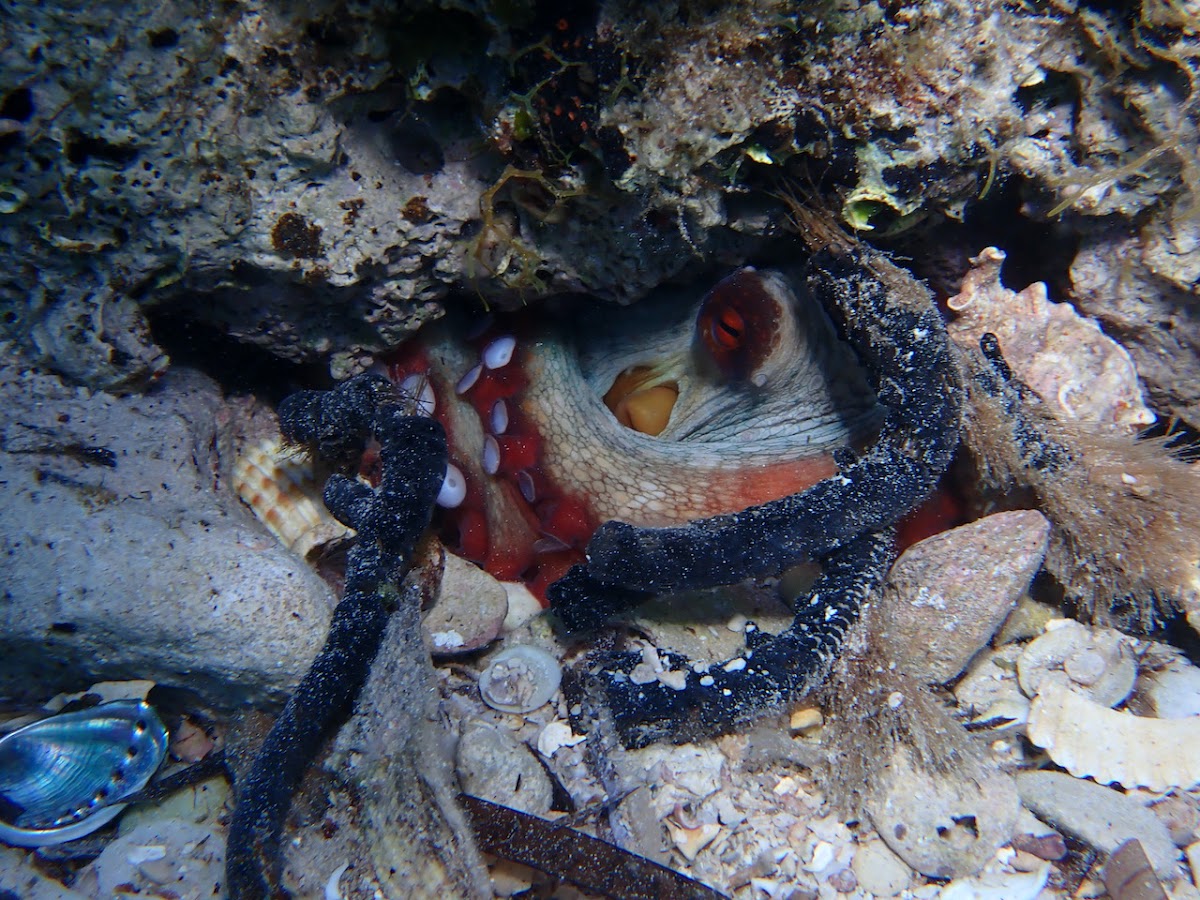
And there were two more octopuses...
...and I think this one was the prettiest of them all. Or at least looked the most like the kraken. Or Jack Sparrow.
Later we sailed to Unije to bay Vognišča and had a nice evening and calm night there. Next day we started early and sailed over the Kvarner bay and along W side of Istra and stopped in bay Polje for swimming. Bad weather and strong NE wind was forecast for the afternoon and the night so we wanted to get to the marina till evening. But all the day NW wind was blowing, so we made another stop for swimming at island Kotez, one of the Brioni islands. On the way we saw many Mediterranean jellyfish or Fried egg jellyfish (Morska cvetača or Cotylorhiza tuberculata).
Then we decided not to sail to the marina but anchored in bay Stinjanska Draga. Even though there is a quarry on one side of the bay, it is quite pretty. There were plenty of boats there in the evening, but we were the only boat that stayed there over night. The wind finally turned to NE and became stronger, but much more annoying than that was loud music from the club on the hill and the restaurant on the beach.
Next morning we sailed into marina and we had one more pleasant surprise there - when we were almost turning into our pier we saw a dolphin. After tying our boat I went to the end of the pier and dolphin was still there. In couple of moments there were tens of people standing on the pier watching. I saw the dolphin again in the afternoon when we were getting to our car to drive home. It was a great end to the great week and great holiday.


Tuesday, August 23, 2022

Holiday in Adria 2022 - part2

The third week, a week after Kornati, we sailed North back to Pula. Our first stop was in Kaprije and although I snorkelled there several times before and it wasn't really good, this time it was fantastic. Maybe it was due to the fact that the weather was glorious or that I haven't snorkel that much this year, but I was very pleasantly surprised.
There were several Mediterranean feather stars (Morska lilija or Antedon mediterrana) there.
And although normally Peacock worms (Pahljačasti cevkarji or Sabella pavonina) are really shy and it takes a lot of diving and luck to get a photo, this one just didn't mind me getting close. But unfortunately it didn't open its tentacles fully.
I also found several Cushion corals (Jadranska kamena korala or Cladocora caespitosa), it is the only coral in Adriatic that forms kind of reefs.
I know I posted plenty of these guys in the past, but Slime tube worms (Peščeni cevkarji or Myxicola infundibulum) are so delicate and pretty.
The Tubular sea cucumber (Navadni brizgač or Holothuria tubulosa) is not very unusual nor very pretty, but this one is in very unusual pink colour.
And to my surprise I found an Octopus (Navadna hobotnica or Octopus vulgaris), even outside the Kornati national park.
I'm not sure what this is, it might be one of the Tunicates, maybe the Jelly synascidian (Prosojni prevlekar or Diplosoma spongiforme). 
This Red tube worm (Pisani pokrovčkar or Serpula vermicularis) has a very colourful "lid" with which it closes off its tube when it feels threatened and after it pulls its tentacles into the tube.
I was happy to find several Red sea squirts (Rdeče kozolnjake or Halocynthia papillosa).

And here is another pretty Red tube worm (Pisani pokrovčkar or Serpula vermicularis).
This was the smallest Black sea urchin (Črni morski ježek or Arbacia lixula) that I ever saw.
And here is another Tunicate, I couldn't find the English name, but in tranlstion it would be "Miniature world", because it usually hosts all kind of sea organisms (Nagubani kozolnjak or Microcosmus spp). In the back there is a completely different animal, a brown sponge.
I don't often manage to take a photo of the Flounder while it is swimming (Morski jezik or Arnoglossus sp.).
After a very promising start I didn't snorkel much the next few days. It was either that we were sailing right when the light would be the best for snorkelling or taking photos, and last two days we had bad weather, even with some rain, so we skipped Olib and ended up in again crowded bay of Artatore on Lošinj. And next day we crossed the Kvarner bay and sailed to marina in Pula, another bad weather front was forecast for the night. On the way we passed the pretty lighthouse Porer.

On Sunday our friends joined us aboard and we sailed South again. First evening we stopped at small island of Bodulaš. Usually there are not too many boats anchored there for the night and there are two big Boškarin bulls on the island, that roam around every evening and morning and they are quite a sight. We had a calm night and in the morning crossed the Kvarner bay again. Our first stop for swimming was SW side of Unije. I went snorkelling again and although I had high hopes, since it is just the sea on W side of Unije all the way to Italy, and no hotels or restaurants anywhere near, it wasn't very interesting. 
The only interesting thing I found was this Tubular sea cucumber (Navadni brizgač or Holothuria tubulosa) that was standing upright. I've seen this once already, it is the sign cucumbers are preparing to mate and release their eggs and sperm into the water.
In the afternoon we stopped at Susak, we tied the boat to the pier and our friends went for a walk up the hill to see the old part of the village and the cemetery. The interesting thing in cemetery is that one mostly sees only four family names on gravestones. I was already up there several times, this year as well, Captain even many more times, so we stayed on boat. In the evening we sailed to Lošinj and for once didn't anchor in Artatore, but in a smaller bay to the W that is called Zabodarski. I was surprised there were only four boats anchored in such a beautiful bay.
It was even prettier in the morning, and I went snorkelling right after morning coffee. It was pretty, but the light was not yet very good for taking photos. But there were very many Mediterranean red sea stars (Ognjenordeča zvezda or Echinaster sepositus).
Towards the noon we sailed off along the Lošinj and stopped in bay Plieski for swimming. We moved further S for the night to the island of Ilovik to the bay Przine. It was again quite crowded, there was more NE wind burja forecast for the night and the bay is quite well protected.
Next day was cloudy and some of the NE wind was still there. We sailed S along the W side of Premuda, just because none of us was there before. We made a stop in one of the wild bays, I think it has the same name as the island. There were lots of fish and marine life in the bay, just the light was not the best because of the clouds, so not all the photos were sharp and good.
Finally I found lots of these pretty guys, I was afraid they are disappearing like the octopuses - they are Red-black triplefins (Rdeči sprehajalček or Tripterygion tripteronotus)
This is Crater sponge (Rjava skorjevka or Hemimycale columella)
This is a Common prawn (Žagasta kozica or Palaemon serratus), I'm amazed every time how translucent it is.
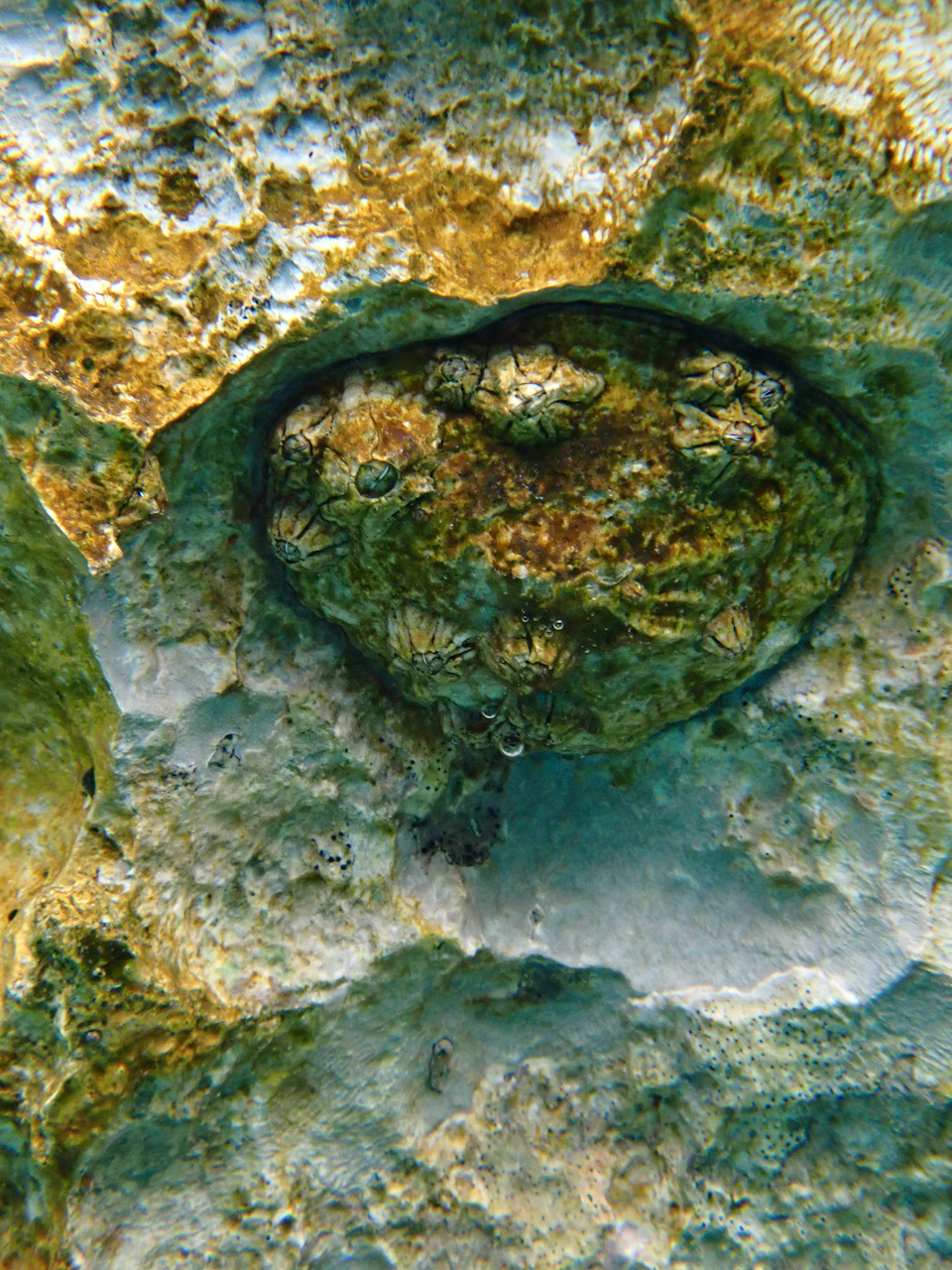
And this remains the mystery of the year, and also of last year. I have no clue what it is other than it's definitely a snail. Last years I also saw one in bay Opat on Kornati, but just as here in a very open bay with very little human presence, and that one was even bigger, but just like this one covered with barnacles (z Morskimi želodki ali Chatamalus depressus). Last year I was thinking it might be some sort of Abalone, but looking at it several more times I'm not sure, I think Abalones are not so symmetrical. And it is too big for a Limpet (Strešico or Patella vulgata). So the detective work continues. 
There I also saw one of the biggest Annular sea breams (Špar or Diplodus annularis).

Sunday, August 14, 2022

Holiday in Adria 2022 - part 1

This summer I spent four weeks on Heron. I travelled to Pula, where Tomaž and Heron were already waiting for me. Then we sailed South. Unfortunately there were a couple of days of bad weather and burja prior to my arrival, and the NE wind was still blowing and the crossing of Kvarner bay was rather bumpy. We slept in Artatore bay on Lošinj, because it is very well protected from the burja. Of course there were plenty of boats there, and although it is a quite a pretty bay with nice clear water, I didn't go snorkelling, and it wasn't just because of crowded bay but also because the water was rather cold.

Next day we sailed to Ist and passed the three small islands of Grebeni (ridges) on the way. The funny thing is that they are called South, Middle and West Ridge. Logically. 

Some years ago I had the bright idea to stop there for snorkelling, because the water around the islands is so deep that no one anchors or even stops there, so it must be very unspoilt. I was sure, my Captain would find a way to anchor Heron for couple of hours. But when we got there we saw that the only not so deep place was between the islands and it was narrow and rocky, so we didn't stop either. But I bet the snorkelling there must be awesome!
I didn't go snorkelling on Ist either, the fresh wind was still blowing and water was still cold. Dipping in the sea was not meant so much for cooling down as for washing. And the same was on Murter. But we had some nice company on both evenings. 
Next night we already slept near Vodice and again I didn't snorkel. Next day our stop was on E side of Kaprije and it looked like the summer was finally there. It was sunny, the sea was warming up as well, there was very little wind and even the evening was warm. It was rather late in the afternoon when we got there and the light was not the best and since I already snorkelled there and it wasn't very good, we were just swimming and lazying around.
Next morning we made a detour to Zmajan and of course I went snorkelling, this time in company. The best thing we saw was couple of beautiful Mediterranean Red sea stars - (Ognjenordeča zvezda or Echinaster sepositus)...
...and couple of Sea flounders (Morski jezik or Arnoglossus spp.)
Then we sailed to Ravni Žakanj in Kornati. Of course in the afternoon I went snorkelling again, after all I had to make up for the whole week. This thing is still a mystery to me, in one of my books it says that these kind of spheres appear in summer and are someone's eggs, but no one knows who's. Usually they are gelatinous translucent spheres lying on the sea bottom, but this was the first that I saw that was attached and floating.
Very pretty Rocky shore hermit crab (Zelenkasti rak samotarec or Clibanarius erythropus) with chequered eyes.
This year I only saw one Bearded fire worm (Ognjeni črv or Hermodice carunculata).
I also found the Red sea squirt (Rdeči kozolnjak or Halocynthia papillosa).
This is the Mediterranean rainbow wrasse (Knez or Coris julis), no other fish I know has the eyes this red
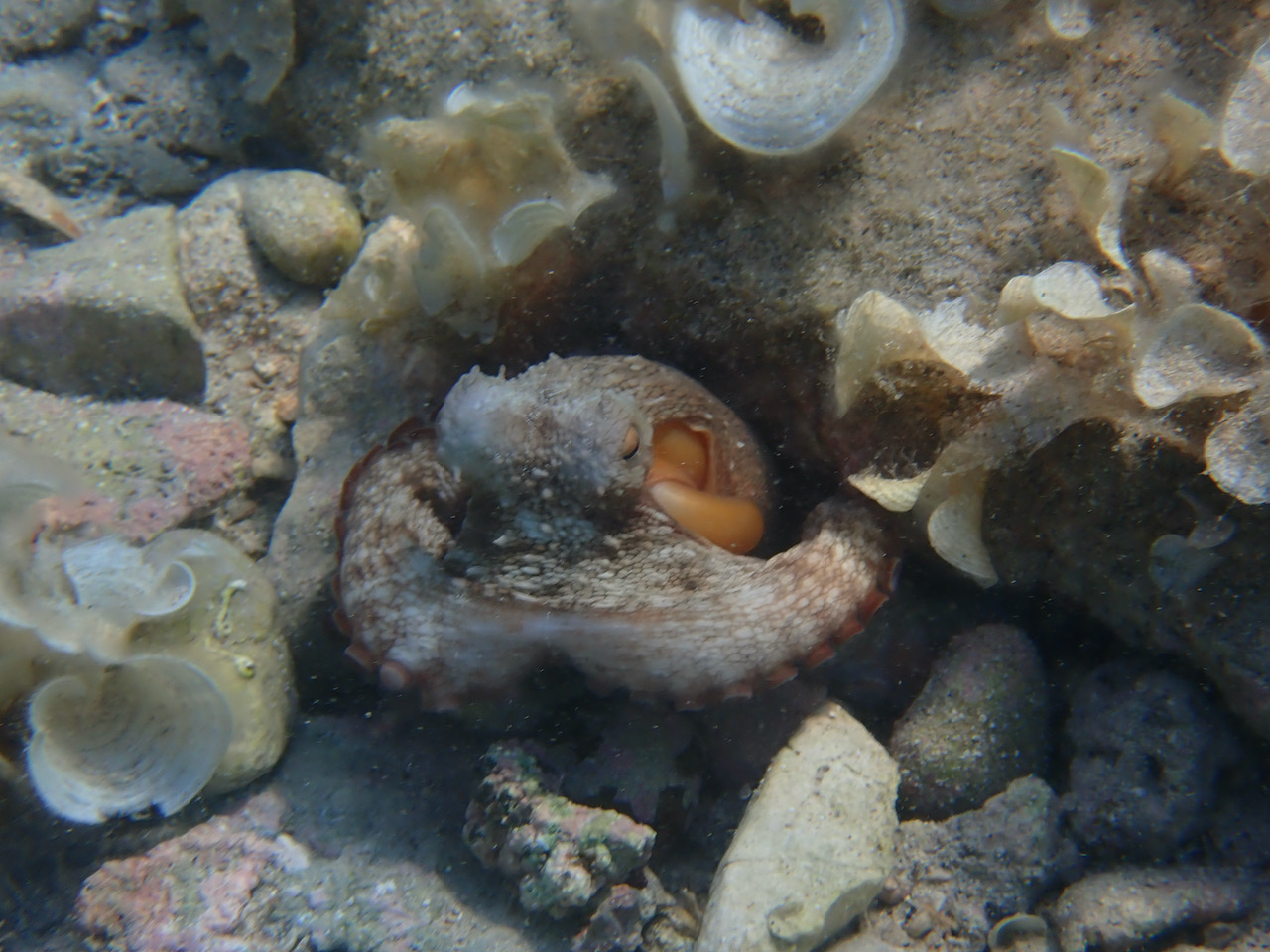
And just because I'm so happy I found so many octopuses (Navadne hobotnice or Octopus vulgaris) that afternoon, I'm posting the photos of all three:


I hope they survived the Italian sailors and local hunters and have the opportunity to grow big and have plenty of babies.
I couldn't resist this pretty face - it is Rusty blenny (Babica papagajka or Parablennius sanguinolentus).
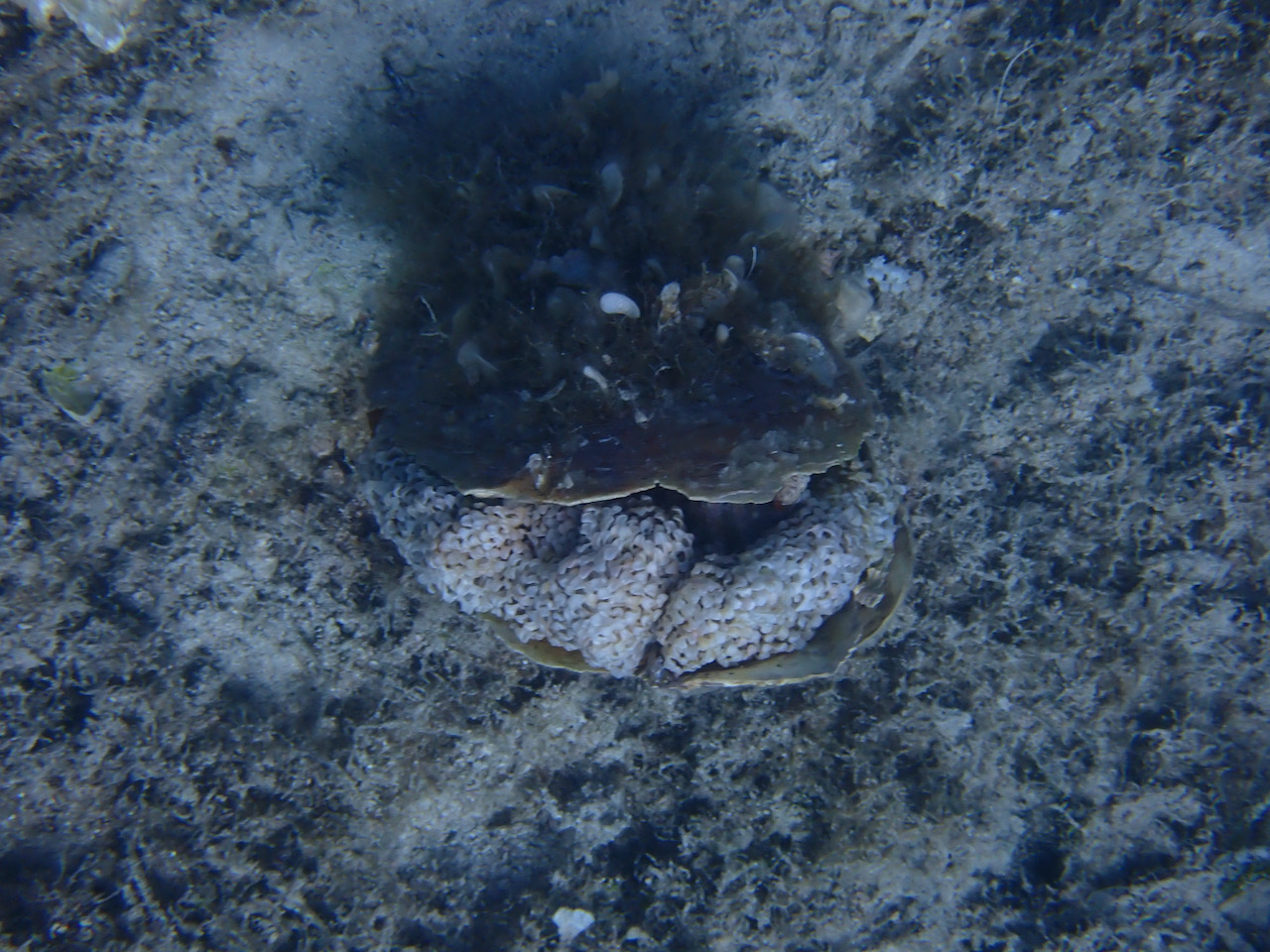
We stayed in Kornati for two more days and I went snorkelling on every day. But even on Kornati the Fan mussels (Leščur or Pinna nobilis) are dead and there are Murex snail eggs (jajca Čokatega voleka or Hexaplex trunculus)...
...or Oysters Ostrige or Ostrea edulis) growing in them. They were destroyed by parasite as in the rest of the Mediterranean, and although I've heard that alive specimens were being seen here and there, I didn't see any.
But the protection of a national park definitely has very positive impact on fish, this is the biggest school of fattest Salemas (salpe or Sarpa salpa) I've ever seen. 
And here are two more octopuses from Kornati.


I was a bit disappointed that I didn't find more nudibranchs - this Hope's Elysia (Pisanček or Thurdilla hopei) was the only one. Sorry for the bad photo.
This monkey face might be a sponge covered in Briozoan (Mahovnjak).
As most people already know, I rarely leave the boat, but since we were tied to the pier on Ravni Žakanj, it was very easy to go for a walk in the evening. We "conquered" the peak of the island and there were some pretty views from the top.
And this is the view over the pier and the anchorage.