Wine country was probably one of our favourite parts of island, with all its cottages, vineyards, flowers and winding but almost empty roads.
A bit further down we met a herd of goats.
Next we stopped in Zarza. It is a site where original inhabitants lived, the ones that Spanish later eliminated. The site is in the cloud forest, laurisilva. There is a small but interesting museum with information and artefacts about life of original inhabitants, and there is a path through the woods to some of the caves where they lived and stones with their carvings. The wood alone is enchanting. I spotted a nice bird nest.
Soon we reached first carvings. They are mostly concentric circles or of elliptical shapes.
This is one of the caves where they lived. First people came to Canary islands from West Africa in some 300 b.c. I can imagine they liked the climate here, it is much nicer than in the desert.
While archeologists don't know what the meaning of carvings could be, Captain found an explanation in seconds - it represents circles in the pool of water when you dip your fingers in. It is true, that in this site there is also a spring, that doesn't go dry even in dry season, but similar shaped carvings have been found also on other sites without water, even the ones around the highest mountain Roque de los Muchchos.
The stroll through the woods took and hour and it was truly beautiful.
I found a patch of violets.
We ended our hike just when they were closing, so we were lucky to get here in time. It would be a pity to miss such lovely and interesting place.
We drove on along North coast of the island towards East and the scenery was very dramatic, many steep drop-offs and the road was cut through the hills.
Due to roadworks we took a detour and found ourselves on this narrow road. Luckily we were the only car there.
The area is really wild and quite sparsely inhabited.
But still one sees bananas wherever they can be planted.
Next day we first drove to Mirador la Cumbrecita, the lookout at the South rim of the big Caldera de Taburiente. We have planned to visit it already the day before, but when we got to the entrance of nature reserve, we were sent back because we didn't have the parking permit. There is a limited number of parking spaces at the end of the road and one has to make the permit reservation on the internet. We stopped a bit away from the entrance and quickly checked the availability, but it was all booked for the day. But we found a half an hour slot for the next day, so we quickly made a reservation. In visitor centre we asked if we could stay a bit longer than half an hour and a nice lady prolonged it to an hour. And we could enter the park 15 minutes before our slot. Great!
After couple of kilometres driving through lovely pine woods we parked our car. This is a great view from parking lot.
We decided to hike to next mirador, it would take us about and hour to get there and back which would be just right. We walked among bent pine trees...
...and came to the next mirador with great views across the caldera. Somewhere up on the other side are all the observatories and Roque de los Muchachos, where we were two days ago. Just today we had a beautiful weather with great visibility.
There were several crows around, we read that they are quite used to get some food from the tourists. Unfortunately we left our sandwiches in the car, otherwise I could maybe photograph them up close.
We've seen quite many trees with their roots partially exposed, must be because of the erosion.
It was a lovely hike and we were happy that we got the whole hour for it. Next we drove to West coast and then along it towards South. We wanted to see some "recent" volcanoes. We stopped at the Visitors centre of Volcan San Antonio. At visitors centre there were some videos and presentations about the geology and recent volcano eruptions. San Antonio erupted some 300 years ago, it's caldera is already filling up because of erosion...
...and trees are already growing in it. We also saw some birds, among them kestrels and crows, that are living there.
There is a nice path around the rim of the volcano.
This is another one of the birds living there.
There was a great view to Volcan Teneguia, which is much younger, it was erupting only in 1970, so in our lifetime. There was an actual video of its eruption in visitors centre. Nothing is growing on that one yet. We would have liked to climb that one as well, but the time was running out.
Teneguia made La Palma a bit bigger than it was before - the pale rock in the middle of the photo was before one of the cliffs above the sea, all the black lava around it and towards the sea, where the bananas are, is new ground.
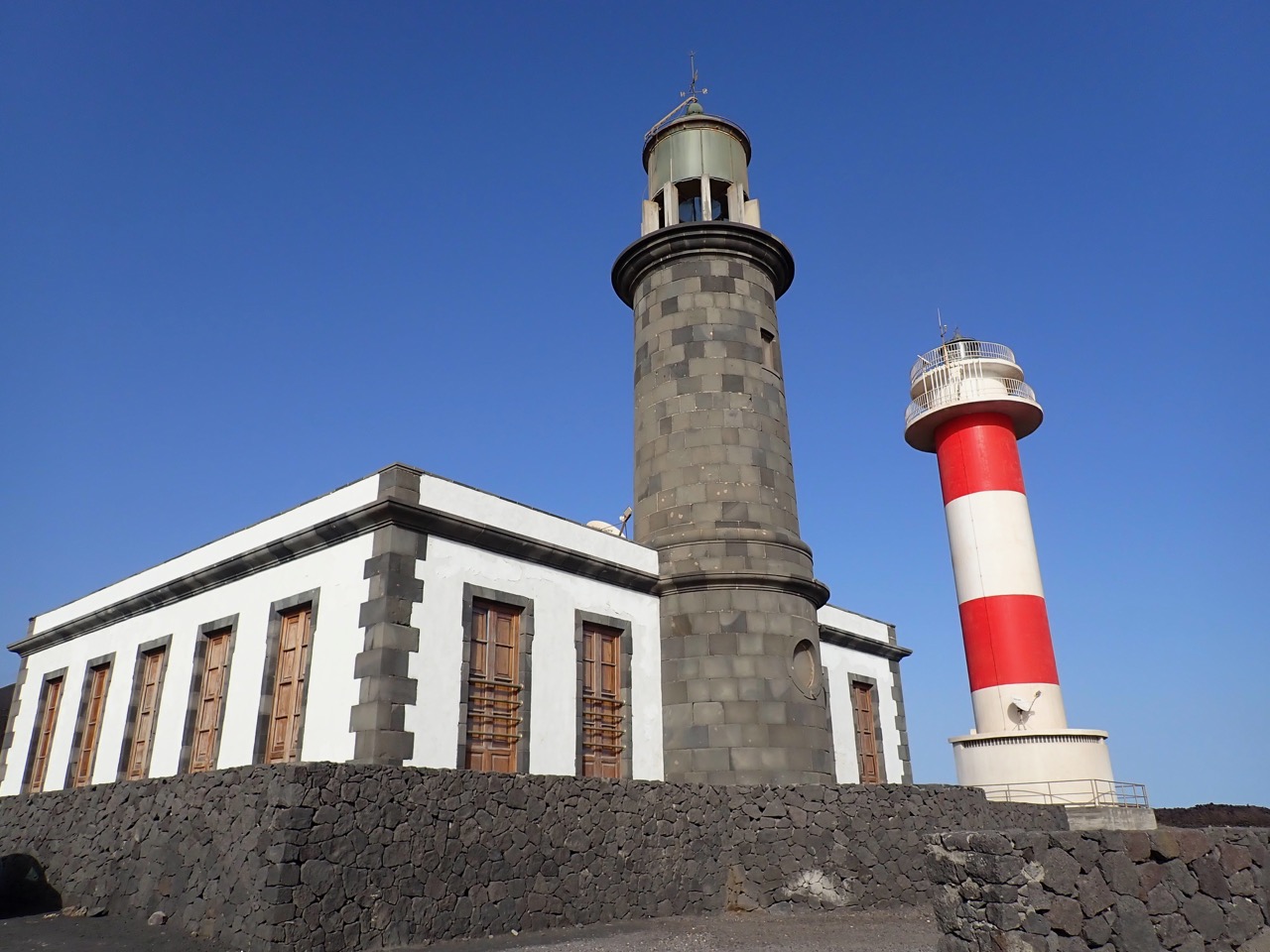
Next we drove to the lighthouse near the South cape. While the lava was flowing in that direction, it missed the old lighthouse (the new one was built later)...
...and the salt plants and flew left and right from them. We took a stroll around salt plants, there is a self-guided tour there with lots of information boards. At this time of year the plants are quiet, only in summer when the temperatures are high there are good conditions for salt production. They produce salt by hand, the old fashioned way, just like in Sečovlje in Slovenija.
Unfortunately the restaurant there is only open till 6 in the evening, so we were too late to get something to eat, but we could get a drink. We met a nice guard dog...
...and had a great views from the terrace, and a great company too.
We decided to make a stop in one of the restaurants along the way back to marina. Well - the first one Google suggested was closed for vacation (Google didn't tell us that), and then there were no more restaurants along the SE coast. I didn't know the coast there was also very steep and very sparsely populated. But in one village we spotted a restaurant that was open and we stopped. Usually when we go out to eat we like to pick restaurants that are special and that offer local food. This one was just a village restaurant, but decent, and while we wouldn't go back, we got fed with decent fish and had a bottle of very good local wine (I had the most of it, Captain was driving). So we (especially I) were happy.
In the meantime it got dark and Captain got the idea, that we should drive to some place where we could do some star gazing, since it is such a big thing on La Palma. We remembered the Mirador la Cumbra from two days ago and although it was out of the way, drove there. Well, we wanted to, but missed it. It is on the road that once was a two way road that climbed into hills and then drove through a tunnel to the other side towards West, and later they built newer longer tunnel much lower in the hill, so the old road is now both lanes in direction West through old tunnel, and new road is both lanes in direction East through new tunnel. So we could not just turn around once we realised we drove passed the mirador, but had to drive further up the hill and then through old tunnel and then down on the other side so we could cross back through the new tunnel and get back to East side. By the time we got there we were fed up with it and went straight to the boat.
On Saturday we took it easy and prepared the boat for a passage back to Lanzarote, that we wanted to start on Sunday morning. It looked like we would have a good weather window for travelling NE, the direction from where the trade winds usually blow. For next couple of days there was more Northerly wind forecast, and rather light one, and most importantly, there would be only very small waves. So if we have to beat against the wind and the waves and the current, that would be the best weather for it.
We bought some bread, fruit and veggies and payed the marina. This is how empty marina is when there's no carnival.
In the evening we went to town for our last carnival mojito, there was again some live music there and lots of children were still dressed up in costumes. Then we went to bed early to be rested for the passage.