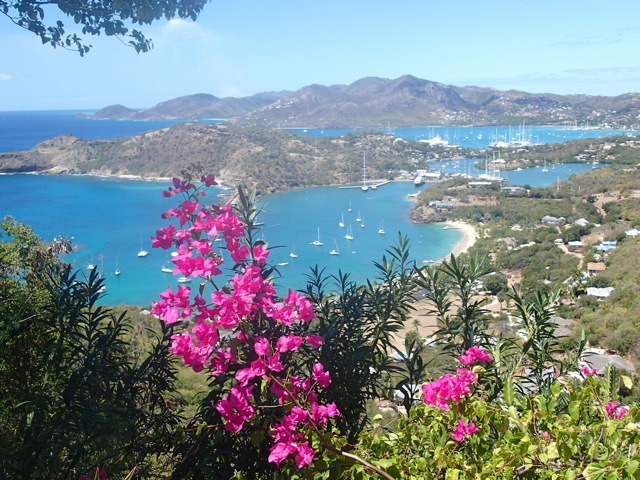
We left Antigua on Sunday morning at around 10. Wind was good and the sailing was nice. Visibility was again very good, we could see Antigua very clearly for a long time ...

... and Montserrat's volcano too.

We reached Deshaies in late afternoon. After we anchored I went into the water to check on our anchor, and as soon as I got in I saw a turtle. Unfortunately our chain was to near to corals so we moved Heron to the spot where we weren't making any damage.
There was a beautiful sunset that evening.


I couldn't wait to go snorkeling. There were a lot of turtles in the bay and I knew snorkeling at the north side of the bay was great. The instant I got in the water there were two turtles circling around me. Pretty!

I saw a Sharptail Eel.


Considering it was cloudy I was pleased with quality of photos my new camera made.

On Tuesday we moved to Pigeon island anchorage. I went snorkeling right away. This boat was almost right beneath Heron in 13m of water. If you look closely, you will see two Lionfsh living in it (the feathery finns in the deepest part of the boat) and a lot of smaller fish around.

There weren't as many turtles there as the last time, Tomaz joked they have moved to Deshaies. But they were patient and allowed me to come close and make photos.

Reef at the northern shore of the bay was beautiful. This is Spanish Hogfish - with yellow makeup!

Sea Plumes forest.

This is the only Cero I saw in last two weeks, we haven't been lucky with fishing lately.

Set of Giant Barrel Sponges.

This is a Maze Coral.

This is a Branching Fire Coral encrusting a Sea Fan. There are two Brittle Stars hidden in the branches, just where the coral forms it's branches at the top.

These are Sea Pearls (don't you just love some of these names?), hidden in a sponge. They belong to the family of green algae. They are one of the largest one cell organisms (up to 7cm diameter).

This is Elliptical Star Coral.

A Christmas Tree Worm on a Mustard Hill Coral.

A Flamingo Tongue up close.

These are Orange Cup Corals living on a sponge. They apparently came to the Caribbean on a ship's bottom from Eastern Pacific or Indo-Pacific, where the species is common, and then spread around with the currents since 1943, when it was first recorded from Puerto Rico and Curacao.

This is Donkey Dung Sea Cucumber.

Around Pigeon Island there were many turtles with Remoras on them - as they grazed on the bottom, the Sharksuckers were attached to the back, and when the turtle swam to the surface for air, they moved to the belly part of the shell. They just want a free ride, but turtles looked like they were annoyed by them and tried to shake them off from time to time.

After a bit rolly night we sailed to Les Saintes. Coastal sailing is always very hard, especially on the western side of Guadeloupe, wind often shifting from East to West, one moment gusting to 32 knots, then dying down completely the next. It is very tiresome, one has to work the sails all the time.
We had a great view of Guadeloupe's highest peak, Soufrierre. There was also some smoke on the top, proving it is still a working volcano. We never saw it so clearly before, neither the smoke coming from it.

We anchored at the Paine de sucree. Next day I went snorkeling again, ready to explore macro functions of my camera.
This is a Slate Pencil Urchin wedged in a crack in a rock. I like how some of his spines are bright red and some covered with algae.

Another pretty Christmas Tree Worm. It lives in the tube that is encased in living coral and catches it's food with it's crowns called radioles. The worm is shy and retracts the crowns into the tube when approached and closes the tube with an operculum that you can see on the left.

This is White Encrustung Zoanthid, it is related to anemones. It is much smaller and lives in colonies.

This photo is actually a bad photo of Golden Crinoid (the feather star). It was supposed to be like two photos below. But just as I was going to delete if, I noticed why my camera didn't focus on the star - there were some tiny little shrimps in the way - the Mysid Shrimp.


And another cute Christmas Tree Worm. How can such a beauty be a worm?

Detail of Mustard Hill Coral.

I found this crab between the branches of the Finger Coral, luckily it was moving or I would have overlooked it. It took me many dives to take this photo. See how the crab is hairy or camouflaged in algae, only his pincers are "clean". And his segmented white and black eyes. I still haven't been able to identify it, the closest thing in my book is Paved Clinging Crab.

Detail of Star Coral.

Baloonfish - with eyes that look like mirror.

Greater Soapfish

The detail of the Grooved Brain Coral - you can see small tentacles on the edges of the ridges.

I am having so much fun with my camera (Olympus TG-2) and my books (Paul Humann & Ned DeLoach trilogy Reef Fish, Reef Coral and Reef Creatures Identification), first taking photos while snorkeling and afterwards studying photos and trying to identify what I saw.