Tuesday, March 26, 2013

Guadeloupe

We left Antigua on Sunday morning at around 10. Wind was good and the sailing was nice. Visibility was again very good, we could see Antigua very clearly for a long time ...


... and Montserrat's volcano too.


We reached Deshaies in late afternoon. After we anchored I went into the water to check on our anchor, and as soon as I got in I saw a turtle. Unfortunately our chain was to near to corals so we moved Heron to the spot where we weren't making any damage.

 There was a beautiful sunset that evening.


I couldn't wait to go snorkeling. There were a lot of turtles in the bay and I knew snorkeling at the north side of the bay was great. The instant I got in the water there were two turtles circling around me. Pretty!


I saw a Sharptail Eel.


Considering it was cloudy I was pleased with quality of photos my new camera made.


On Tuesday we moved to Pigeon island anchorage. I went snorkeling right away. This boat was almost right beneath Heron in 13m of water. If you look closely, you will see two Lionfsh living in it (the feathery finns in the deepest part of the boat) and a lot of smaller fish around.


There weren't as many turtles there as the last time, Tomaz joked they have moved to Deshaies. But they were patient and allowed me to come close and make photos.


Reef at the northern shore of the bay was beautiful. This is Spanish Hogfish - with yellow makeup!


 Sea Plumes forest.


This is the only Cero I saw in last two weeks, we haven't been lucky with fishing lately.


Set of Giant Barrel Sponges.


This is a Maze Coral.


This is a Branching Fire Coral encrusting a Sea Fan. There are two Brittle Stars hidden in the branches, just where the coral forms it's branches at the top.


These are Sea Pearls (don't you just love some of these names?), hidden in a sponge. They belong to the family of green algae. They are one of the largest one cell organisms (up to 7cm diameter).


This is Elliptical Star Coral.


A Christmas Tree Worm on a Mustard Hill Coral.


A Flamingo Tongue up close.


These are Orange Cup Corals living on a sponge. They apparently came to the Caribbean on a ship's bottom from Eastern Pacific or Indo-Pacific, where the species is common, and then spread around with the currents since 1943, when it was first recorded from Puerto Rico and Curacao.


This is Donkey Dung Sea Cucumber.


Around Pigeon Island there were many turtles with Remoras on them - as they grazed on the bottom, the Sharksuckers were attached to the back, and when the turtle swam to the surface for air, they moved to the belly part of the shell. They just want a free ride, but turtles looked like they were annoyed by them and tried to shake them off from time to time.


After a bit rolly night we sailed to Les Saintes. Coastal sailing is always very hard, especially on the western side of Guadeloupe, wind often shifting from East to West, one moment gusting to 32 knots, then dying down completely the next. It is very tiresome, one has to work the sails all the time.

We had a great view of Guadeloupe's highest peak, Soufrierre. There was also some smoke on the top, proving it is still a working volcano. We never saw it so clearly before, neither the smoke coming from it.


We anchored at the Paine de sucree. Next day I went snorkeling again, ready to explore macro functions of my camera.

This is a Slate Pencil Urchin wedged in a crack in a rock. I like how some of his spines are bright red and some covered with algae.


Another pretty Christmas Tree Worm. It lives in the tube that is encased in living coral and catches it's food with it's crowns called radioles. The worm is shy and retracts the crowns into the tube when approached and closes the tube with an operculum that you can see on the left.


This is White Encrustung Zoanthid, it is related to anemones. It is much smaller and lives in colonies.


This photo is actually  a bad photo of Golden Crinoid (the feather star). It was supposed to be like two photos below. But just as I was going to delete if, I noticed why my camera didn't focus on the star - there were some tiny little shrimps in the way - the Mysid Shrimp.


The portrait of Treespot Damselfish - damselfish are very protective and brave, they would try to scare off even much bigger animal than themself - like myself. That's why it is possible to make good photos of them - because the fish comes to you. Once I was even bitten by one and another tried to bite my camera.


And another cute Christmas Tree Worm. How can such a beauty be a worm?


Detail of Mustard Hill Coral.


I found this crab between the branches of the Finger Coral, luckily it was moving or I would have overlooked it. It took me many dives to take this photo. See how the crab is hairy or camouflaged in algae, only his pincers are "clean". And his segmented white and black eyes. I still haven't been able to identify it, the closest thing in my book is Paved Clinging Crab.


Detail of Star Coral.


Baloonfish - with eyes that look like mirror.


Greater Soapfish


The detail of the Grooved Brain Coral - you can see small tentacles on the edges of the ridges.


I am having so much fun with my camera (Olympus TG-2) and my books (Paul Humann & Ned DeLoach trilogy Reef Fish, Reef Coral and Reef Creatures Identification), first taking photos while snorkeling and afterwards studying photos and trying to identify what I saw.


Tuesday, March 19, 2013

The dry season in Antigua

On Tuesday late afternoon, after snorkeling, we walked to English Harbour. On our way we saw Cattle Egret on the fence. It is called so because it usually spends it's days around grazing cattle and feeds on insects. It is much smaller than Great White Egret, that is often seen in Slovenija.


We couldn't resist a photo in front of our favorite restaurant, Trappas.


After strolling through English Harbour we had a snack in Galley Bar. Coconut shrimps were delicious, but on our way back we decided that we still have a room for dessert and stopped in Cape Horn. They serve true French desserts, and all were yummy.


Next day we dinghied to Freemans Bay to walk up to Shirley Heights. As I saw how great the water looked around Bishops Reef, I was almost sorry I didn't go snorkeling again.


We passed by the entrance to English Harbour....


... and tied the dinghy to the small dock at the Galleon Beach in Freemans Bay.


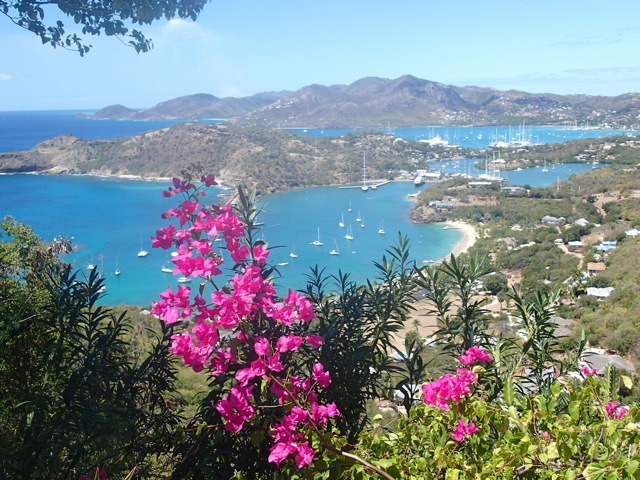
It looked pretty with all the anchored boats and smoking Montserrat as a backdrop.


The trail up to Shirley Height was nice, but it was pretty hot. It was almost noon already and maybe we should have started earlier. The vegetation looked dried out and brown, it is no wonder since it haven't rained here for weeks, if not months.


There are lots of Agava plants along the trail, here they call them Century plants, because they bloom only once in their whole long lifetime.


The views were great from many points of the trail ...


... but even better from the top.


I took a photo of this Antillean Crested Hummingbird, I think my new camera is doing it's job much better than my old one has.


After a Pina Colada at the "summit" we returned down the same way and then we dinghied across the anchorage to English Harbour. We had a nice Roti and smoothie there. There were Bananaquits (the small yellow, black and white birds) helping to "clean" the tables after every meal.


We saw this Ruddy Turnstone in Falmouth Harbour the same day as we went shopping.


In the evening we sailed to Carlisle Bay. There was only one more boat there and it felt peaceful and quiet after lively Falmouth. In the fading light of the evening we first saw an Osprey flying low over our boat, and the the real treat - an West Indian Whistling Duck, rare and endangered local duck. Both birds we saw only because we heard them first, they both have very distinctive cry. I learned how Osprey sound not so long ago in Nonsuch Bay, and how the ducks sound last May also in Nonsuch bay.

Next day we sailed to Five Island Bay. The visibility was unbelievably good, we could see Guadeloupe, that is over 40 miles (75 km) away, Montserrat with it's smoking volcano, Nevis and even St Kitts.


I guess the visibility was so good because of dry air, that is the result of such long dry weather. But dry weather brings along also it's bad sides, not just that plants get brown and dry and even die, there are fires starting on many places in Antigua. I know I'm gonna regret saying this, but I really wish for some heavy rain!


Five Island Bay looked pretty in afternoon sun, there were only two boats anchored on the north side. We also anchored there, south side is prettier but the swell, even small, is making the nights there uncomfortable.


We swam, read, and girls and captain went dinghy-sailing in the afternoon.


We stayed in Five Islands Bay until next afternoon, then we moved to Jolly Harbour. It was time to say goodbye and in the evening captain dinghied the girls to the shore to catch a cab to the airport.

We stayed in Jolly Harbour that night and the next. We did some shopping on Saturday and cleared out, and on Sunday morning we sailed to Guadeloupe.

Saturday, March 16, 2013

Horror nights in paradise

First night in Antigua we spent in Jolly Harbour. We checked out Carlisle Bay in the South, then Fryers bay in the West, but both were too rolly for the night. The storms in North Atlantic and North America send large waves down here, and the swell is making many anchorages, that are usually very nice, unsuitable for anything but a short stop.

In the evening we heard the dolphins swimming around our boat. Unfortunately it was too dark to see anything. Next day we moved around the corner to Five Island Bay. These are two of five islands.


The bay is big and shallow, with manny pretty sandy beaches. Believe it or not, despite the amount of time we spend in Antigua, this was our first visit here. It was perfect summer day, water nice and warm. We enjoyed the freedom of not having to do anything and not having to go anywhere.

 In the afternoon we saw two dolphins swimming into the bay. Later one of them came by and swam under our boat. What a nice sight! I suspect they were the ones from Jolly Harbour from the night before.


On Tuesday afternoon we sailed back to Jolly to pick up the girls, Janja and Lidija, who came to spend ten days on board of Heron with us. We then sailed straight back to our Five Island anchorage, it is much nicer for bathing, and I was hoping that dolphins might come back. But all we got was a big swell in the night, that kept us all awake the most of the night. We hadn't have a night like this for a long time, we always check weather reports and pick the calm places for the night. But this time the weather report was wrong, the swell was much bigger then forecast. I was sorry for Lidija and Janja, to have such a lousy first night, and for Jana and Grega to have such lousy last night with us.

Next afternoon we returned to Jolly Harbour to dinghy Jana and Grega ashore, so they could catch their plane. The rest of us went shopping to make provisioning for next ten days, and afterwards we decided to stay in Jolly for the night and not risk another sleepless night. In the evening we met with Madeline and Skip of Saralane, we met them last April in Barbuda and haven't seen them since them. It was so nice to catch up a bit.

On Thursday we sailed to Deep Bay. Wind was very weak and from the West. We knew that meant there was disturbance in trade winds, that are normally blowing here. And the wether report confirmed that - the storms in West Atlantic changed the wind even this far South.

We enjoyed the day, swimming, watching the turtles and climbing up to the fortress. And I started to learn to use to my new camera, the girls brought along, the Olympus TG-2.


On Saturday it was March the 8th, the Women day - captain remembered and each of us got a plate of papaya with lime and a heart for breakfast. How sweet!


After breakfast we sailed to Barbuda. We studied the weather and saw that this was the only real opportunity in the days to come.

Well, there was not much sailing anyway. This is how the sea looked. Calm as a mirror.


So we were motoring all the way. This is what we ate for lunch - classic Slovenian walnut potica. The girls brought it from Slovenija, and it tasted great.


Happy crew enjoying the views after nice lunch.


It was already half past three as we anchored the boat in Coco Bay. My first thought was to get into the water and snorkel my tunicates. According to forecast the swell would get even bigger during the night and I had a new camera to try out. Despite bad visibility and little light I managed to shoot some decent photos. I still have a lot to learn about the camera though.


The evening was hot and without the wind, like the day was. The air didn't move, not  even a little. We went for a swim even after dinner to cool down a bit. In the night the horror begun. Somehow hundreds of sand flies (or sand fleas or "no see ums") find the way into our boat and ate us alive. These little creatures are a menace on evening walks on the sandy beaches or during the beach barbeque, but they are very poor flyers and even weak wind hinders them to fly out to anchored boats. In all our time here we only had them in the boat once, last year in Freeman Bay in front of English Harbour, when couple of them made it to the boat in the night without the wind (and this is one of the reasons why I don't like that anchorage and we almost never anchor there any more). Even with no wind I never thought they would manage to invade Heron, that was anchored about 150m from the beach. We tried keeping them off us with bug repellents, but nothing worked. We didn't know what to do. Their stings felt like needles, and even though we managed to kill a lot of them, we looked like we had chicken pox (norice) by the morning - all covered with red bite marks. 

The swell got considerably bigger by morning too - and after the breakfast we decided to return to Antigua straight away. There was no snorkeling or going ashore because of the swell, and there still was absolutely no wind. We didn't want to risk another horror night with sand flies.

We motored all the way back. It was really unusual, to have the sea so flat and calm. But it was also very beautiful, we could see the corals on the bottom even at 20m depth.


On the way we got a bit of rain, finally after many weeks of dry weather. At last our boat was washed, but to thoroughly get rid of all the salt, we would need a stronger shower that that. But the clouds and the rain brought a bit of wind with them and we were able to sail for 15 minutes. Shortly before Antigua we caught a Cero, that we ate that evening.

We entered the Nonsuch Bay through Spitthead channel, we did it before, but it was getting dark and visibility was really bad. I was very nervous, but I managed to steer the boat clear of all reefs and even keep it in water deeper than 10m. Navigating Spitthead channel is very tricky, mostly because the charts are incorrect and it is not possible to sail by them. The channel that charts (Garmin, Navionics..) show is offset quite a bit to the west, the real channel is much more to the east than shown in the charts. One has to keep to the outer, eastern reef, where the water is deep, and avoid the inner, western reef, where the water gets shallow quick. And ignore the charts. If one sails like this, the water in channel is deeper than 10m all the time, although chart plotter shows the position of the boat being right on eastern reef.

Nonsuch Bay looked really busy, there were almost 40 boats there and all the buoys were taken, so we dropped an anchor. But luckily there was a bit of wind and we had a quiet night. Well, all did but me. I had very strong reaction to the bites and I woke up often and went into the cockpit to cool down the skin with vinegar and different ointments.

Next day we did some snorkeling, but the visibility was so bad, I didn't even manage one photo with my new camera. This is Janja and me, getting ready to go snorkeling.


We stayed in Nonsuch Bay for another night. This time I was smarter - I took a pill that helped ease the allergic reaction I was having and I managed to have a fairly good nigh.

On Monday we sailed to Falmouth Harbour. The wind got stronger and we had nice sailing. In the evening we went to Trappas for the dinner. We all enjoyed it very much.

Next day Janja and I went snorkeling on Bishops Reef and it was a good opportunity to test my camera.  And I was impressed with the results. And I haven't even read the manual yet!

This is Sun Anemone.


Flamingo Tongues (the small shell-looking nudibranches) eating a Gorgonian coral.


Another Gorgonian - Yellow Sea Whip.


One of the sponges.